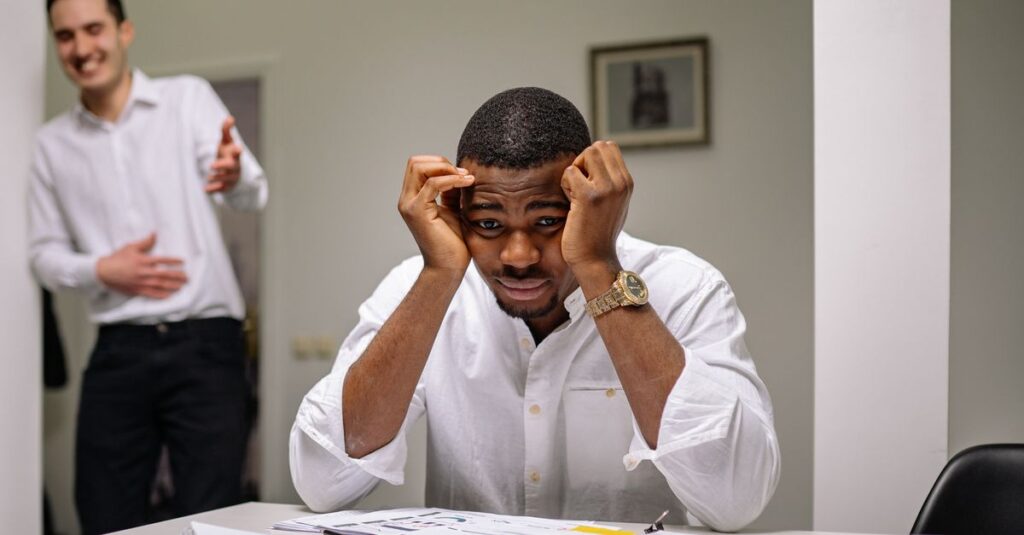

Performance Anxiety: Why It Happens and What Can Help
Estimated reading time: 9 minutes
Key takeaways
- Performance anxiety is worry about being judged while doing a specific task; it is a broad everyday term, not a diagnosis on its own.
- Rehearsing the actual task, testing feared predictions, and bringing attention back to the task may help with a specific upcoming performance.
- Seek professional support if anxiety leads you to avoid situations, affects your work or relationships, or disrupts daily life.
- Sexual symptoms can have physical, medication-related, relationship, or other causes as well as anxiety, so persistent or troubling symptoms warrant healthcare advice.
- Don’t take prescription medication for performance anxiety without discussing it with a healthcare professional.
Table of contents
- Performance Anxiety: Why It Happens and What Can Help
- What performance anxiety can feel like
- Why the fear can build
- Strategies for a specific upcoming performance
- Rehearse the actual task
- Test the prediction, not just your confidence
- Give your attention somewhere useful
- Make the performance about the task, not your worth
- When performance anxiety may be part of a larger problem
- When the concern is sexual performance
- Be cautious with medication advice
- Frequently asked questions
- What is performance anxiety?
- When should I seek professional help for performance anxiety?
- What can I do before an upcoming performance?
- Can performance anxiety affect sexual activity?
- Should I take medication for performance anxiety?
What performance anxiety can feel like
Performance anxiety is worry about being judged while doing a specific task, such as giving a presentation, taking an exam, competing in a sport, auditioning, or having sex. It can bring racing thoughts, physical tension, or an urge to avoid the situation. Some nerves are common; anxiety is more concerning when it causes significant distress or gets in the way of something important to you.
“Performance anxiety” is a broad everyday term, not a diagnosis on its own. The most useful response depends on where the anxiety shows up: preparing for a talk calls for different practical steps than dealing with persistent anxiety about sexual activity. If the fear is frequent, leads you to avoid situations, or disrupts daily life, a mental health professional or clinician can help assess what’s behind it.
Anxiety may start well before the event. You might replay what could go wrong, imagine other people noticing a mistake, or struggle to focus on preparation. As the event approaches, physical signs can include a pounding heart, trembling, sweating, a dry mouth, nausea, or muscle tension.
People may experience these symptoms in different combinations. Research on music performance, for example, often distinguishes anxious thoughts from physical symptoms and self-confidence rather than treating anxiety as one single feeling (review of music-performance anxiety research).
A little arousal doesn’t automatically mean something is wrong. Some people find that anticipation helps them feel alert. The concern is when anxiety becomes distressing, distracts from the task, or encourages avoidance. Nor does anxiety always predict poor performance: a study of football players and musicians found no correlation between measured anxiety and performance, though the study’s sample and design limit how widely its findings can be applied (study).
Why the fear can build
Performance situations make evaluation feel possible. If you expect a mistake to bring embarrassment, rejection, or a serious consequence, your attention may shift away from the task and toward monitoring yourself: Is my voice shaking? Do they look bored? What if I freeze?
That monitoring can feed a cycle:
- You predict a bad outcome.
- You become more alert to signs that it might happen.
- Physical symptoms or a small stumble seem to confirm the prediction.
- You avoid, rush through, or over-control the task.
- Because you don’t get a chance to experience the situation differently, the fear remains convincing.
Avoidance may bring short-term relief, but it can make the next similar situation feel harder. The aim isn’t to force yourself into every stressful situation without support. It’s to understand what you fear and, when appropriate, practise approaching the task in manageable ways.
Strategies for a specific upcoming performance
When the event is approaching, focus on what you can practise and influence. These steps may help you prepare, though none can guarantee that anxiety will disappear.
Rehearse the actual task
Practise in a way that resembles the event, rather than only thinking through what you’ll do. For a presentation, say it aloud and use the slides or notes you’ll bring. For an audition, practise beginning under conditions that feel similar to the audition. For a test, work through sample questions if they’re available.
A realistic run-through can reveal practical problems—unclear wording, missing materials, or a confusing opening—while there’s still time to address them. It can also make the sequence of actions more familiar. Rehearsal is a commonly reported coping strategy among musicians, but research doesn’t establish that practice alone will resolve performance anxiety (music-performance review).
If rehearsing the whole event feels overwhelming, start with one piece: the first minute of a talk, the opening of a musical passage, or a single practice question. Build from there. The goal is preparation, not proving that you can perform perfectly.
Test the prediction, not just your confidence
Write down the specific outcome you fear. “I’ll make a mistake” is more useful to examine than “Everything will go badly.” Then ask what you think would happen if the mistake occurred, and whether your past experience supports that conclusion.
For example, someone preparing to present a project might predict, “If I lose my place, everyone will think I’m incompetent.” A more balanced possibility is, “I might pause, check my notes, and continue. People may notice, but one pause won’t tell them everything about my work.” This doesn’t promise that the presentation will go smoothly. It separates a possible mistake from the worst-case meaning attached to it.
Cognitive behavioral therapy (CBT) uses approaches such as examining unhelpful beliefs and gradually facing feared situations. Those skills can be useful on your own, but a therapist can help when the predictions are difficult to shift or avoidance has become entrenched (UW Medicine’s overview of performance anxiety).
Give your attention somewhere useful
Just before the task, try a brief grounding exercise: notice your feet against the floor, identify a few things you can see, or focus on the first concrete action you need to take. If you choose to slow your breathing, keep it comfortable rather than forcing deep breaths or trying to control every physical sensation.
Grounding, relaxation, and mindfulness are suggested coping strategies for stage fright, but they aren’t guaranteed fixes (Cleveland Clinic). If monitoring your breathing makes you more self-conscious, drop the exercise and return your attention to the task itself—for instance, the first sentence of your talk or the next step in a routine.
Make the performance about the task, not your worth
A performance is something you do; it isn’t a complete measure of who you are. That distinction can help reduce the pressure to treat every outcome as a verdict on your ability or value. You can still take preparation seriously while allowing that a stumble, imperfect score, or awkward moment doesn’t define you.
When performance anxiety may be part of a larger problem
Some people fear only a particular kind of performance. Others experience strong fear across many situations where they might be judged, such as meeting new people, speaking in groups, or eating in front of others. Social anxiety disorder can involve fear limited to performance situations or fear across a wider range of social situations (National Institute of Mental Health).
Occasional nerves don’t by themselves mean you have a disorder. NIMH describes social anxiety disorder as involving fear that persists for at least six months and interferes with daily life, alongside other diagnostic criteria. A clinician—not a checklist or a single stressful event—can help determine whether those criteria fit.
Consider seeking professional support if anxiety leads you to turn down opportunities, affects your work or relationships, or keeps returning despite attempts to manage it. CBT is a commonly used, research-supported treatment for social anxiety, according to NIMH. A clinician can help clarify whether the concern is specific to one performance setting or part of a broader difficulty.
Research into performance-focused interventions is promising but not conclusive. A 2023 review and meta-analysis of 20 studies involving performing artists and professional athletes reported a large pooled effect of psychological interventions on state anxiety—anxiety at a particular time—and a small effect on trait anxiety, a more persistent tendency toward anxiety. The authors also noted that the evidence base is limited and called for more research, particularly on lasting change (systematic review and meta-analysis). Techniques involving imagery, reframing, and self-talk showed promise, but findings vary; a review of imagery studies couldn’t establish that imagery alone caused improvements or identify the best approach (review).
When the concern is sexual performance
Anxiety around sex can involve fear of not getting or maintaining an erection, not meeting a partner’s expectations, or being judged. Stress and worry can contribute to sexual difficulties, but they aren’t the only possible explanations. Physical health, medication, relationship concerns, and past experiences can also matter.
If sexual symptoms are new, persistent, or troubling, it’s better to consult a healthcare professional than assume anxiety is the sole cause. Treatment depends on what’s contributing: a clinician may assess physical concerns, while therapy may help with anxiety, relationship issues, or past trauma (Cleveland Clinic’s guide to sexual performance anxiety). Avoid turning intimacy into a pass-or-fail test; a partner may be able to help by talking openly about pressure and expectations, but communication doesn’t replace medical assessment when symptoms continue.
Be cautious with medication advice
Don’t take prescription medication for performance anxiety without discussing it with a healthcare professional. NIMH notes that beta-blockers are commonly used for the performance-only type of social anxiety disorder, but whether a medication is appropriate depends on the person and situation (NIMH).
For example, propranolol can lower blood pressure and may be unsuitable when an elevated heart rate is needed, including during exercise or sex. A clinician can discuss potential risks and whether any medication makes sense for you (UW Medicine). It isn’t a universal or do-it-yourself solution.
If you have an upcoming event, choose one realistic part of it to practise and write down the outcome you fear most. If anxiety is repeatedly narrowing your choices or affecting your life, make an appointment with a clinician or therapist to talk through what’s happening. This article is for education and isn’t a substitute for personalized medical or mental health care.
Frequently asked questions
What is performance anxiety?
Performance anxiety is worry about being judged while doing a specific task, such as giving a presentation, taking an exam, competing in a sport, auditioning, or having sex. It is a broad everyday term, not a diagnosis on its own.
When should I seek professional help for performance anxiety?
Consider seeking professional support if anxiety leads you to turn down opportunities, affects your work or relationships, keeps returning despite attempts to manage it, or disrupts daily life. A mental health professional or clinician can help assess what’s behind it.
What can I do before an upcoming performance?
Practise a realistic part of the task, write down the specific outcome you fear, and bring your attention back to the first concrete action you need to take. These steps may help you prepare, though none can guarantee that anxiety will disappear.
Can performance anxiety affect sexual activity?
Anxiety around sex can involve fear of not getting or maintaining an erection, not meeting a partner’s expectations, or being judged. Physical health, medication, relationship concerns, and past experiences can also matter. If sexual symptoms are new, persistent, or troubling, consult a healthcare professional.
Should I take medication for performance anxiety?
Don’t take prescription medication for performance anxiety without discussing it with a healthcare professional. Whether a medication is appropriate depends on the person and situation, and a clinician can discuss potential risks and whether any medication makes sense for you.