
Meditation: What It Is, What It Can Do, and How to Start
Estimated reading time: 7 minutes
Key takeaways
- Meditation trains attention or awareness; you don’t need to stop thinking or follow one specific technique.
- Some mindfulness-based approaches may help with mental-health symptoms, but meditation is not a guaranteed treatment or a replacement for needed care.
- Start with a comfortable position and a manageable amount of time, returning gently to a chosen point of attention when your mind wanders.
- Meditation is generally considered to have few risks, but difficult experiences can happen. You can stop or adapt your practice if it causes distress.
Table of contents
- Meditation: What It Is, What It Can Do, and How to Start
- Key takeaways
- What meditation means
- What meditation may help with—and what research can’t promise
- How to meditate: a short beginner practice
- How long should you meditate?
- Common beginner difficulties
- Is meditation safe?
- A practical next step
- FAQ
- Do I need to stop thinking to meditate?
- How long should a beginner meditate?
- Can meditation replace mental-health care?
- What should I do if meditation feels distressing?
What meditation means
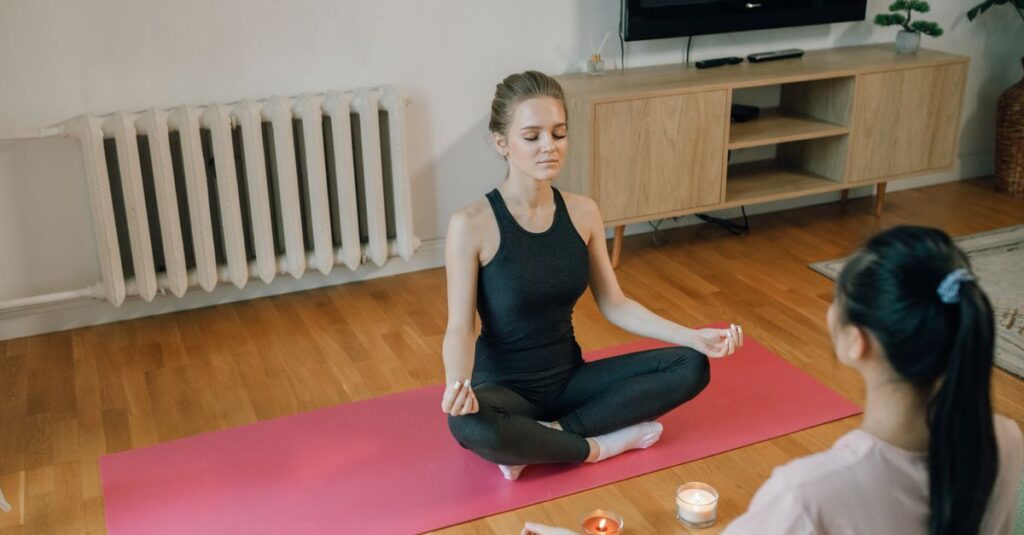
Meditation is a group of practices that train attention or awareness. You don’t need to stop thinking, sit cross-legged, or meditate for a set amount of time to begin. For a simple first session, sit somewhere comfortable, focus on your breath or another steady point of attention, and gently return to it whenever your mind wanders.
Meditation may help some people manage stress, anxiety, or low mood, but it isn’t a guaranteed treatment. Research covers many different practices and outcomes, so results depend on what’s being studied—and how it’s compared. It can be one part of supporting your wellbeing, but it shouldn’t replace medical or mental-health care you need. The National Center for Complementary and Integrative Health (NCCIH) summarizes both the potential benefits and the limits of the evidence.
There isn’t one standardized meditation technique. Some practices ask you to focus on a single thing, such as your breathing, a sound, or a repeated phrase. Others invite you to notice thoughts, emotions, and bodily sensations as they arise, without immediately judging or trying to change them.
Mindfulness meditation is one commonly used approach. Mindfulness means paying attention to what’s happening in the present moment. In practice, you might notice the feeling of breathing, realize you’ve started planning your day, and then return your attention to the next breath.
Other formats include guided meditation, in which a recording or instructor gives prompts, and body-focused practices that move attention through sensations in different parts of the body. Programs such as mindfulness-based stress reduction (MBSR) and mindfulness-based cognitive therapy (MBCT) use mindfulness practices within structured courses. These approaches aren’t interchangeable: a study of one program doesn’t automatically establish the effects of every meditation practice.
What meditation may help with—and what research can’t promise
Some evidence suggests mindfulness-based approaches can help with mental-health symptoms. NCCIH reports that these approaches can reduce anxiety and depression compared with no treatment. In some analyses involving more than 12,000 participants, they performed similarly to evidence-based therapies. That finding doesn’t mean every meditation method works as well as therapy for every person, or that meditation should replace treatment.
For anxiety-related symptoms, NCCIH describes meditation therapy as having a small-to-modest benefit. It also notes that well-designed, adequately powered studies involving people with diagnosed anxiety disorders remain limited. So it’s reasonable to view meditation as a possible support, not a certain solution. Read NCCIH’s summary of the evidence on anxiety and complementary approaches.
The comparison matters, too. An intervention may look more helpful when researchers compare it with no treatment than when they compare it with an activity that also provides attention, structure, or support. In one meta-analysis of clinical-population research, meditation showed small effects on stress and well-being when compared with active alternatives. The study discusses how comparison groups affect the size of reported benefits.
For physical concerns, avoid broad promises. Research on mindfulness-based approaches and chronic pain suggests they may help some people, but findings for acute pain haven’t shown consistent reductions in pain severity. That doesn’t establish meditation as a pain treatment for everyone. NCCIH’s pain overview describes the mixed findings. More generally, studies vary in the practices, program lengths, participants, and outcomes they examine. It’s difficult to use evidence about one specific program to make claims about meditation as a whole.
How to meditate: a short beginner practice
You can meditate in an ordinary chair. A quiet place may make it easier to concentrate, but special clothes, cushions, and equipment aren’t required. The NHS recommends choosing a comfortable, supported position and notes that there’s no fixed session length; its beginner guidance suggests 20 minutes as a guide. If that feels like too much, start with a shorter session you can manage. See the NHS guide to meditation for beginners.
Try this simple breath-focused practice:
- Get comfortable. Sit with your back supported and your feet resting on the floor, if that feels natural. Let your hands rest somewhere easy.
- Choose an anchor. Notice the breath moving in and out. You don’t need to deepen or control it. If focusing on breathing feels uncomfortable, use a neutral sound or the sensation of your feet on the floor instead.
- Notice when attention wanders. You might start thinking about a task, replaying a conversation, or wondering whether you’re doing it right.
- Return gently. Acknowledge the distraction and bring your attention back to your chosen anchor. You can silently label the next breath “in” and the one after it “out,” if that helps.
- Finish gradually. When the timer ends, pause and notice your surroundings before standing up.
The aim isn’t to keep your mind perfectly still. It’s to notice that attention has moved and practise returning it. Each return is part of the exercise, not evidence that you’ve failed.
How long should you meditate?
There’s no research-backed session length that suits everyone. A short session may be easier to fit into your day, while a longer one may give you more time to settle into the practice. Neither is automatically better for you, and the available evidence doesn’t establish one ideal duration or schedule across meditation techniques. The NHS offers 20 minutes as a guide, not a requirement.
Begin with a length that feels sustainable. If five minutes seems manageable, try that rather than setting a demanding target you’re unlikely to keep. After a few sessions, you can decide whether you’d like to stay at that length, add a few minutes, or practise less often. Use comfort and consistency as practical guides; don’t assume that more time will always bring more benefit.
If you prefer external structure, try a guided session. A voice can cue you to return to the present when your attention drifts, which some beginners find useful. But if the instructions make you tense or the pace doesn’t suit you, switch to another recording or practise without one.
Common beginner difficulties
“My mind won’t stop thinking.” That’s not a sign that you’re bad at meditation. Thoughts are part of experience. Notice them, then return to your anchor without trying to force them away.
“I keep checking whether it’s working.” You don’t have to measure each session by whether you feel calm afterward. Instead, treat the session as a chance to practise paying attention. Some days may feel easier than others.
“Sitting still makes me uncomfortable.” Try a more supportive chair or choose a different anchor, such as sounds or contact with the floor. You can stop if discomfort increases. Meditation isn’t a test of endurance.
“I missed a day, so I’ve lost the habit.” A missed session doesn’t erase previous practice. Restart with a manageable session when it fits your routine; there’s no need to make up for missed time by meditating longer.
Is meditation safe?
Meditation is generally considered to have few risks, but it isn’t accurate to describe it as risk-free. Safety research is limited. In a review of 83 studies involving 6,703 participants, 55 studies reported negative experiences; the review estimated that about 8% of participants experienced negative effects, with anxiety and depression among those most often reported. That estimate comes from a particular review and shouldn’t be treated as a universal rate for every practice or person. NCCIH discusses the review and the limits of safety research.
If a session brings up troubling feelings, you can stop, shorten the next session, open your eyes, or switch to a grounding activity such as noticing nearby sounds or the feeling of your feet on the floor. You don’t need to push through distress to make the practice worthwhile.
If you have a mental-health condition, or meditation seems to worsen symptoms, consider discussing it with a health professional and choosing an instructor with suitable experience. Meditation may complement care, but don’t use it as a reason to delay needed support or stop prescribed treatment. NCCIH’s guidance on anxiety approaches also emphasizes the limits of the evidence.
A practical next step
Choose a time today when you can sit comfortably for a few minutes. Pick one anchor—the breath, a sound, or the feeling of your feet on the floor—and practise returning to it when your attention wanders. When you finish, note whether the length and approach felt manageable. Use that response to choose what to try next.
FAQ
Do I need to stop thinking to meditate?
No. The aim isn’t to keep your mind perfectly still. Notice when attention wanders and gently return it to your chosen anchor.
How long should a beginner meditate?
There’s no research-backed session length that suits everyone. Begin with a length that feels sustainable. The NHS offers 20 minutes as a guide, not a requirement.
Can meditation replace mental-health care?
No. Meditation may complement care, but it shouldn’t replace medical or mental-health care you need, delay needed support, or be a reason to stop prescribed treatment.
What should I do if meditation feels distressing?
You can stop, shorten the next session, open your eyes, or switch to a grounding activity. You don’t need to push through distress to make the practice worthwhile.